Can Claude Free's Copy Button Change JSON String Values?
Published 21 November 2026 · Observed 20–21 November 2026 · Claude Free · Sonnet 4.6 / Low
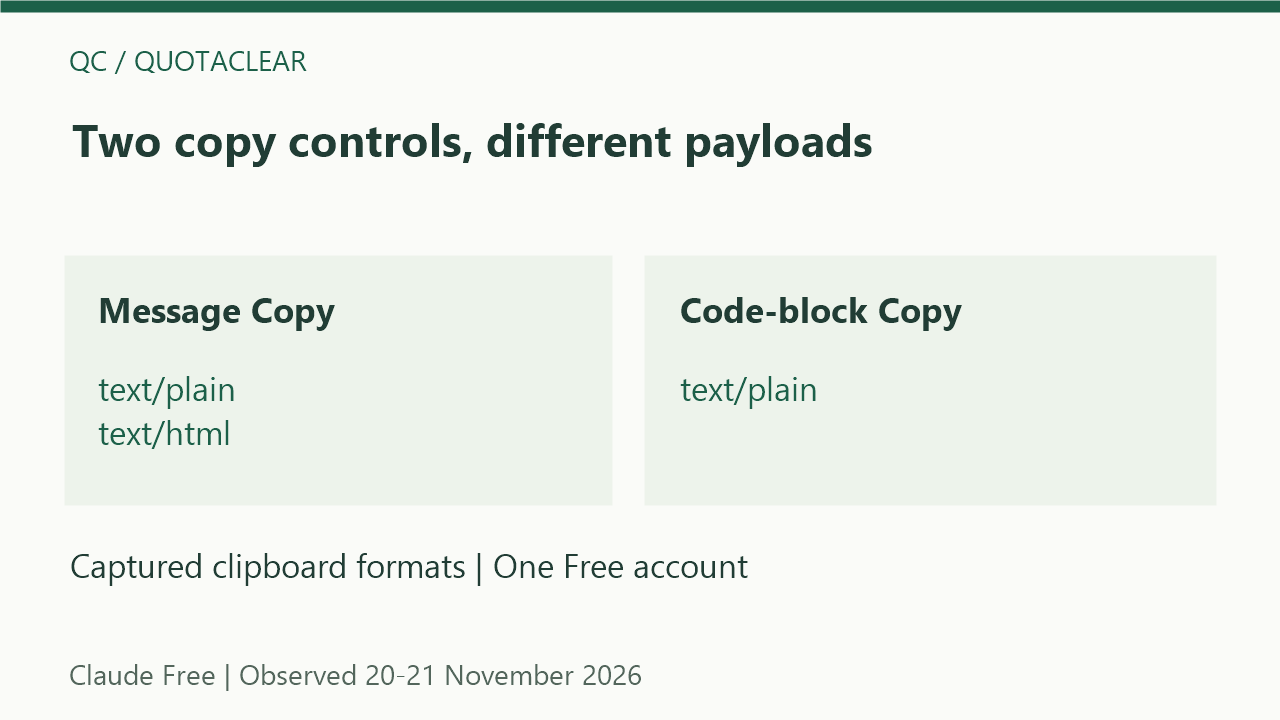
Yes: in the captured clipboard formats from our Claude Free sample, the same message supplied JSON strings with different decoded values.
Copying only the matched code block preserved the original values in this run; inspect the parsed values as well as syntax.
Our November 20–21 checks used one signed-in Free account in Chrome on Windows, with Sonnet 4.6 and Low selected, and asked for harmless strings in ordinary paragraphs and a JSON code block.
We captured the clipboard formats, decoded the HTML with Chrome's DOMParser, and tested the resulting strings with Node.js JSON.parse and exact value comparison.
The earlier exact-output account instruction was removed and its empty value verified before the later string-fidelity request.
Parsing success and value equality
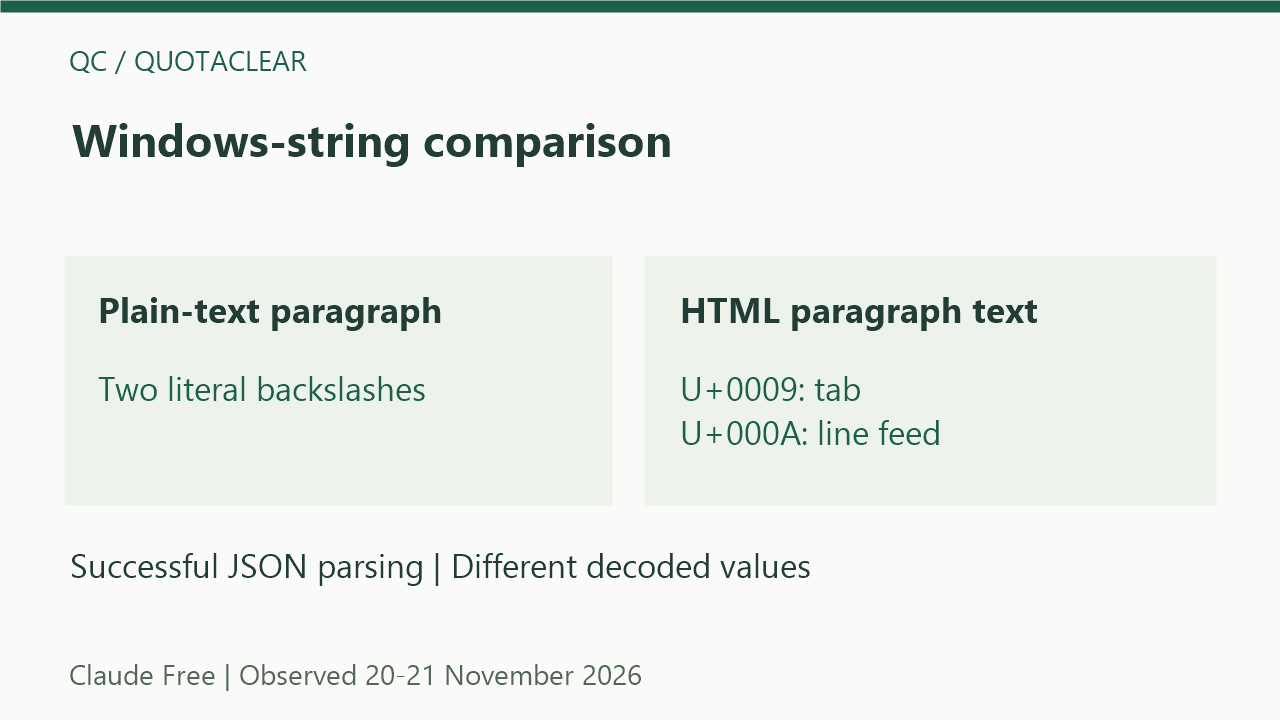
For the Windows input, plain-text Copy preserved two literal backslashes in x, while the HTML-derived JSON still parsed but contained U+0009 and U+000A in their place.
For the Markdown-marked string, both paragraph channels parsed, but the HTML-derived x was amber green while plain text retained the asterisks and underscores.
For the literal A&B input, plain text retained that exact sequence whereas the HTML-derived x became A&B.
The literal <b>amber</b> string provided a contrast: it survived in both paragraph channels, with the tag escaped inside the clipboard HTML rather than becoming bold content.
In a second response, the escaped-solidus URL retained its backslashes in plain-text Copy and lost them in HTML paragraph text, yet both parsed x values still equalled the input URL.
In that response, the Markdown-link JSON retained its full source string in plain-text Copy but parsed as amber from HTML paragraph text, while the target URL remained in the HTML anchor attribute.
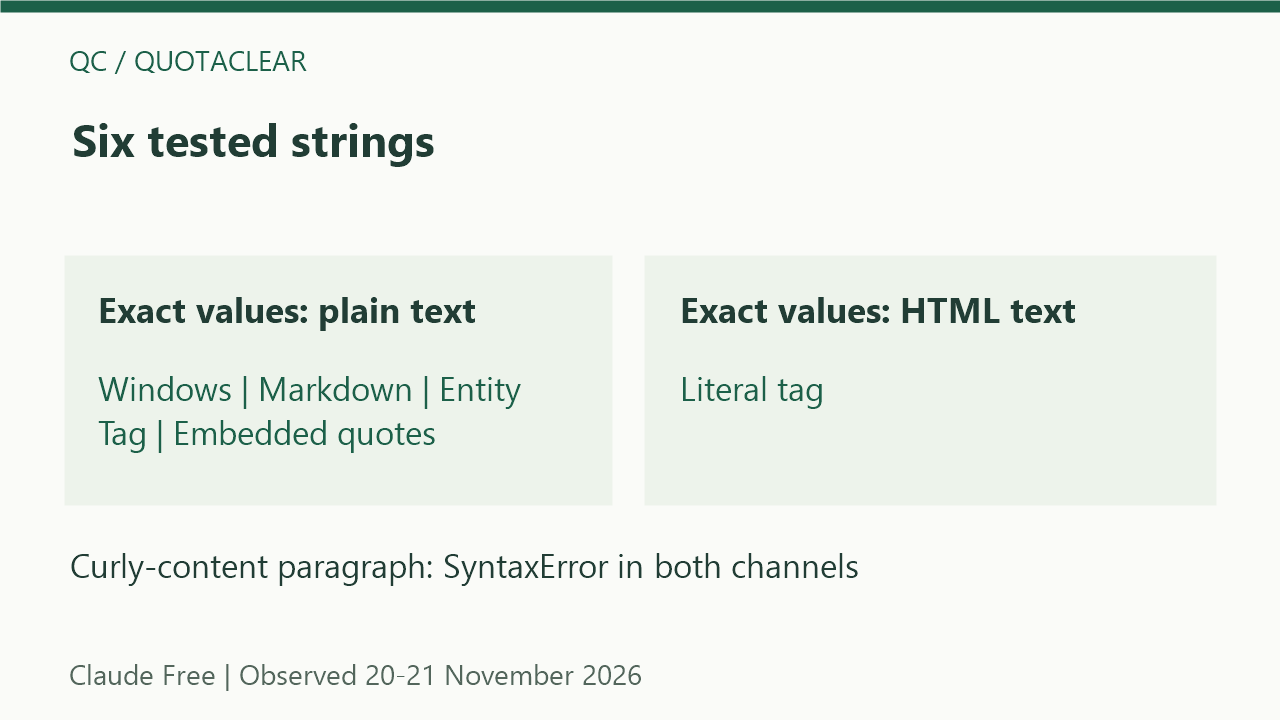
| Input object | Plain-text Copy | HTML paragraph text |
|---|---|---|
Windows{"x":"C:\\temp\\new"} | Valid / exact{"x":"C:\\temp\\new"} | Valid / different{"x":"C:\temp\new"} |
Markdown{"x":"**amber** _green_"} | Valid / exact{"x":"**amber** _green_"} | Valid / different{"x":"amber green"} |
Entity{"x":"A&B"} | Valid / exact{"x":"A&B"} | Valid / different{"x":"A&B"} |
Tag{"x":"<b>amber</b>"} | Valid / exact{"x":"<b>amber</b>"} | Valid / exact{"x":"<b>amber</b>"} |
Curly{"x":"“already curly”"} | SyntaxError | SyntaxError |
Escaped{"x":"She said \"yes\""} | Valid / exact{"x":"She said \"yes\""} | SyntaxError |
Solidus{"x":"https://example.com/path"} | Valid / exact{"x":"https://example.com/path"} | Valid / exact{"x":"https://example.com/path"} |
Link{"x":"[amber](https://example.com/path)"} | Valid / exact{"x":"[amber](https://example.com/path)"} | Valid / different{"x":"amber"} |
Quote syntax and text layers
For the embedded-quotation sample, plain-text Copy produced valid JSON with the expected interior quotes, but the HTML paragraph lacked their backslashes and raised SyntaxError.
The already-curly input failed in both copied ordinary-paragraph channels because its inner quotation marks appeared as unescaped ASCII quotation marks.
In the earlier ordinary-paragraph controls, amber ended with a curly closing quote, whereas amber2 retained an ASCII closing quote after the digit.
In a separate one-object response, the assistant's accessibility heading contained ASCII JSON while its visible paragraph contained curly quotation marks.
In an earlier exact-output single-object reply, Copy returned ASCII-delimited JSON in both clipboard formats despite curly quotes in the visible paragraph.
A matched code-block control
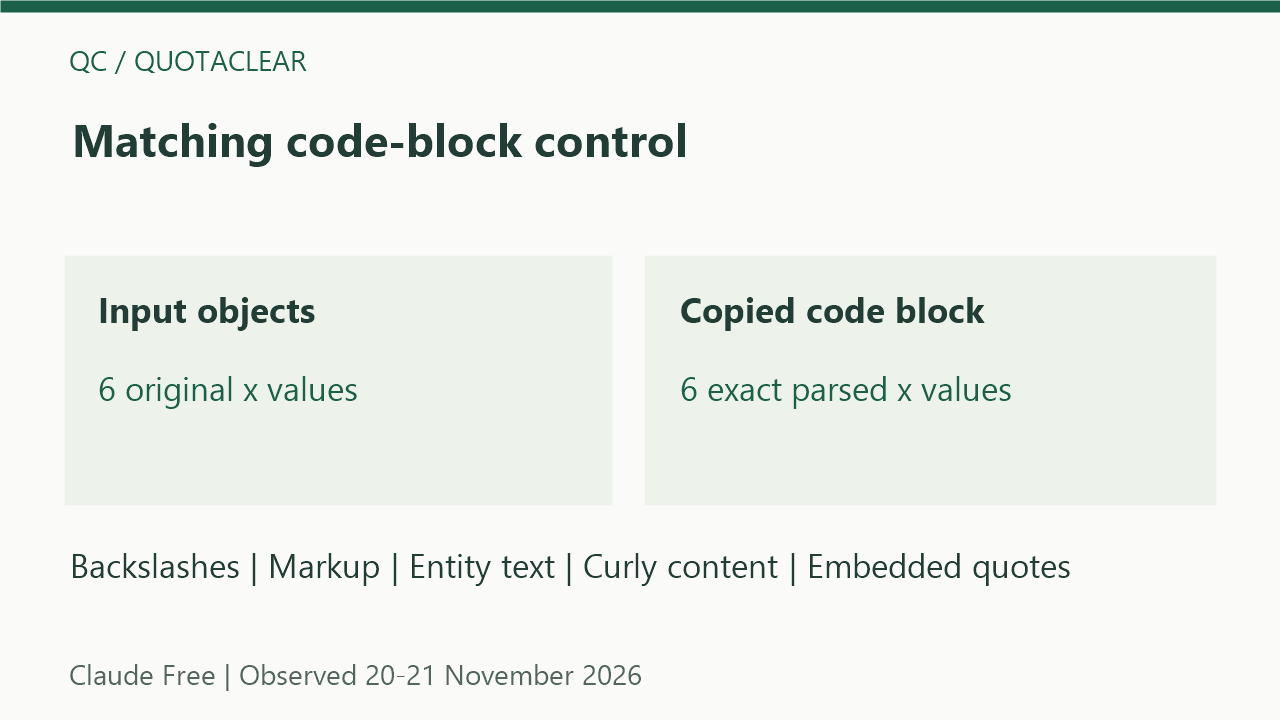
After copying only the explicit six-object code block, all six parsed x values matched the supplied input strings, including the original curly quotation marks.
Its clipboard item contained only text/plain, whereas copying the complete reply also offered text/html.
An initial instruction to repeat six values produced five strings and an array instead of the original keyed cases, so we excluded that answer as a matching object control and issued the explicit object request.
Records, method and limits
The complete message's plain text retained labels and code fences, so we extracted the individual JSON lines before testing them.
The downloadable record includes the exact test inputs, captured clipboard formats, HTML paragraph text and value comparisons, and the parser source can rerun those captured-string checks locally.
These results describe captured text, not a test of how Word, Google Docs or another editor chooses a clipboard format or how a screen reader speaks it, and they measure no API call or Claude usage limit.
A reload check preserved the earlier prose/code display difference, but neither that result nor the clipboard reads exposes the model's raw output or the server's stored text.
Our English background comparison used fully read bodies and directed queries, rather than claiming that every current top-ten result was fully readable.
The observations apply to these response formats and samples in one account, not a guarantee for every model, browser, account or future version.