Does Claude Free Really Remove Hidden Content From a Redacted PDF?
Published 22 November 2026 · Observed 22 November 2026 · Claude Free · Sonnet 4.6 / Low
In our test, the sanitized Claude Free download no longer contained the target codes in the objects we checked, but Claude rebuilt that PDF, while its separate black-cover version retained hidden content and even exposed parts of the covered lettering.
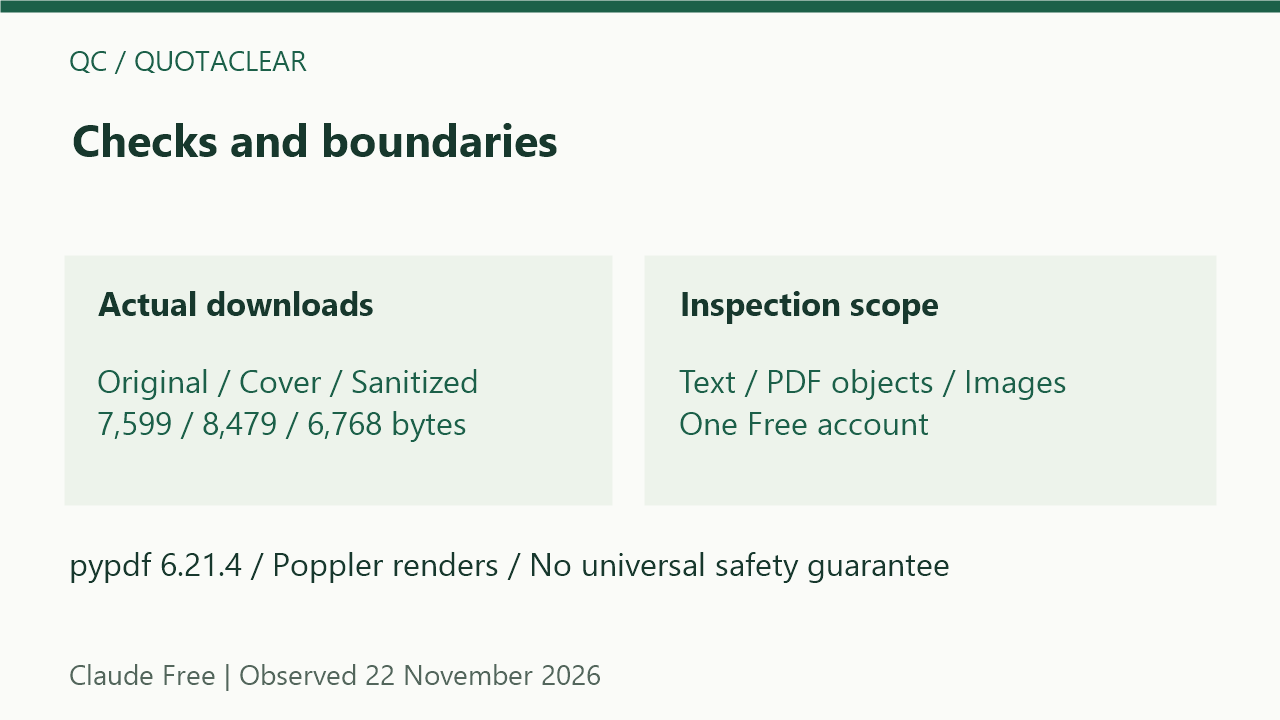
On 22 November 2026, we used one Claude Free account in the original Chrome with Sonnet 4.6 / Low to create a three-page PDF containing harmless test codes in visible text, an image and hidden document objects.
We requested two independent copies from that original, one with deliberately visual-only covers and one with target values removed, then continued an interrupted response in the same conversation before downloading the resulting files.
The codes were artificial inputs rather than personal information, and the evidence below comes from the actual service downloads rather than locally reconstructed response files.
Visible covers and extracted content
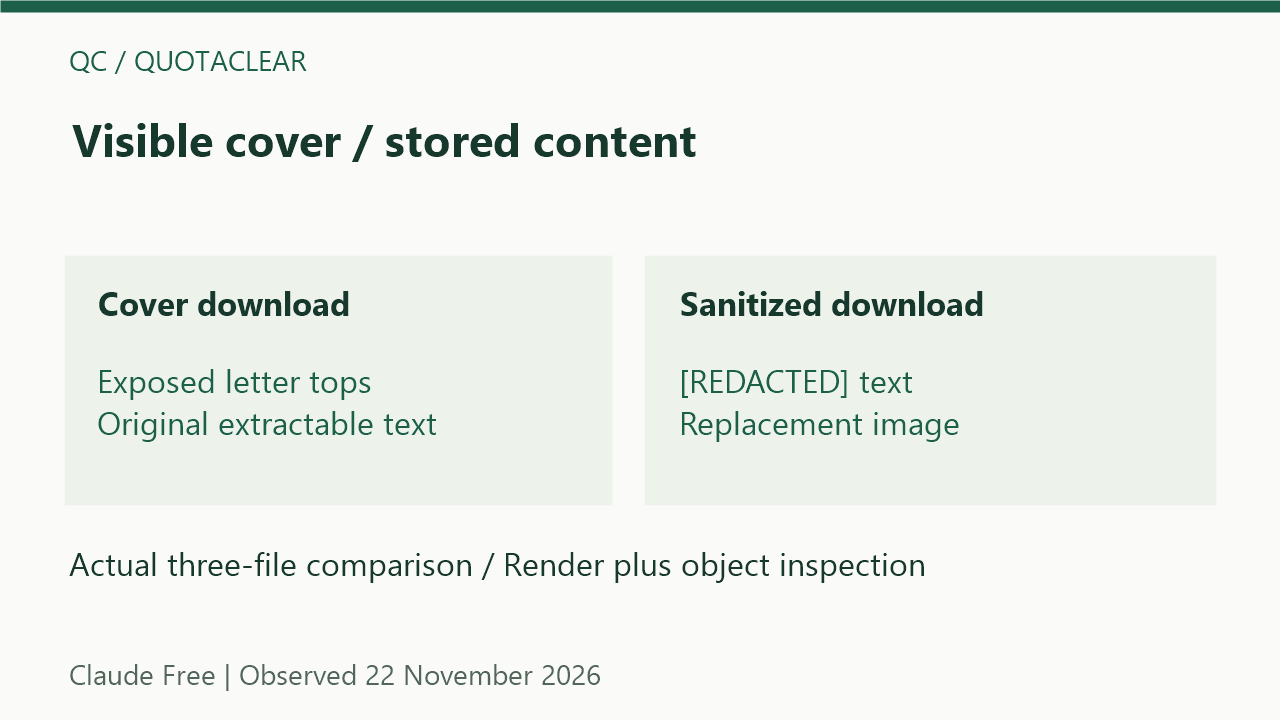
The original and cover PDFs both yielded QCSECRET-TEXT-22 and the private middle of the mixed line in text extraction, whereas the sanitized file yielded [REDACTED] at those locations with PUBLIC-LEFT and PUBLIC-RIGHT still on either side.
Rendering the cover download showed black rectangles below the tops of the page-one target letters and across part of the neighboring public text, so this particular output failed even the intended visual concealment.
The original and cover downloads contained byte-identical extracted page-two images showing QCSECRET-IMAGE-22, while the sanitized download contained a different image showing [REDACTED] instead.
That image-only control did not appear in the original page's extracted text, which is why an empty text search alone would have missed an entire tested content surface.
Hidden objects in the downloads
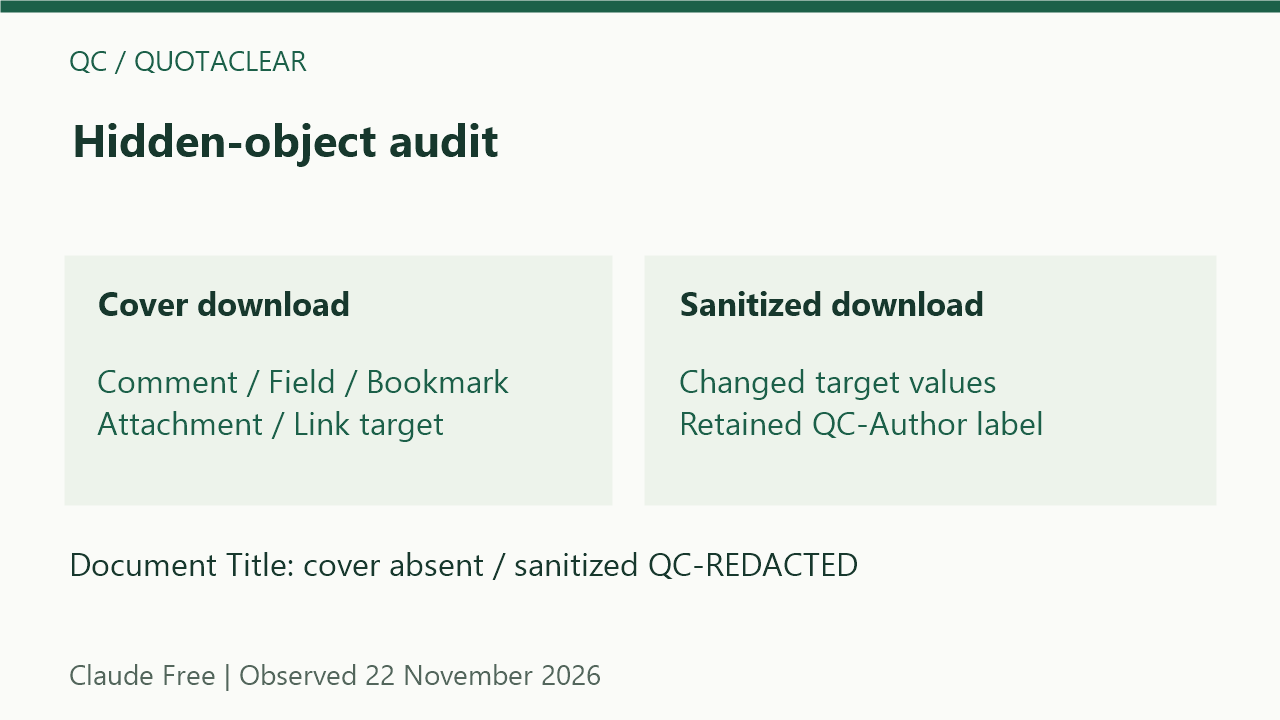
The original Title field held QCSECRET-METADATA-22, the cover download unexpectedly had no exposed document-info metadata, and the sanitized download held QC-REDACTED rather than an empty title.
The page-one comment retained QCSECRET-COMMENT-22 in the cover copy and changed to [REDACTED] in the sanitized copy, while its separate QC-Author attribution remained present.
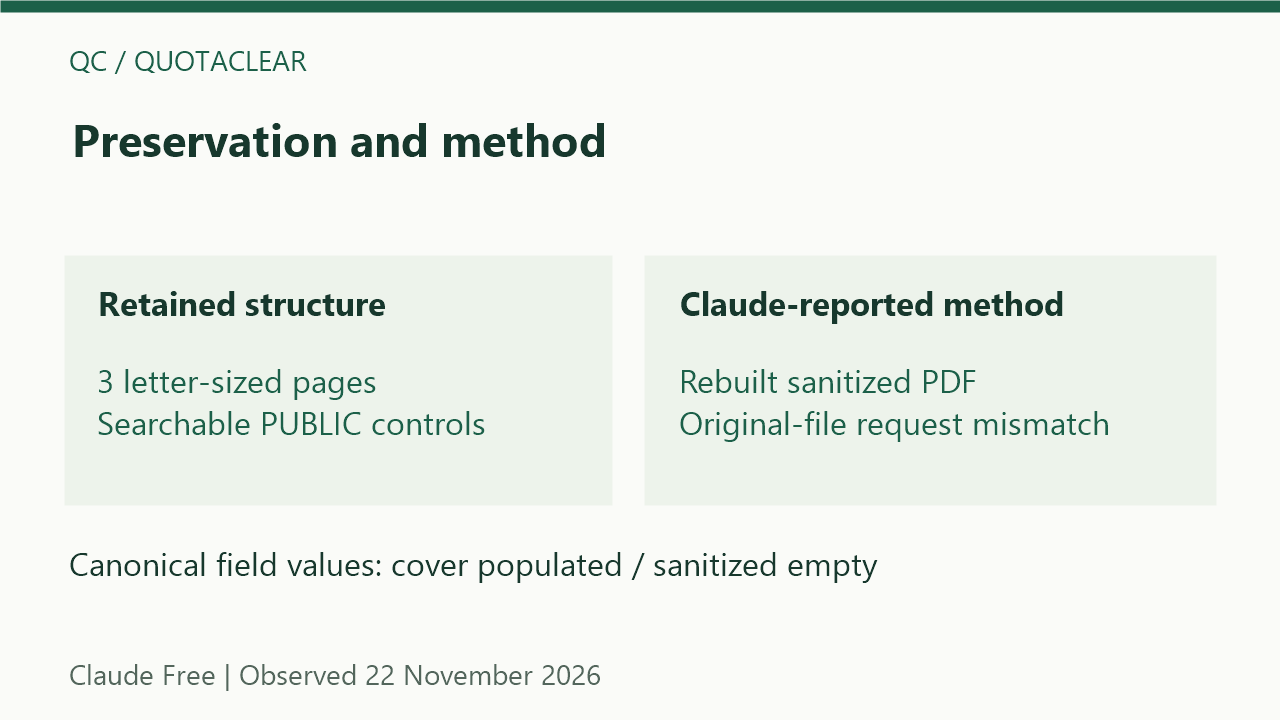
The audit_note field retained its original code in both current and default values in the cover PDF and had both values cleared in the sanitized PDF, despite the original field already appearing blank in our page render.
The cover copy kept the secret bookmark title, while the sanitized copy retained a page-one bookmark named BOOKMARK-REDACTED-22 instead of removing the outline entirely.
The embedded audit.txt attachment survived in all three downloads, but its decoded contents changed from QCSECRET-ATTACHMENT-22 in the original and cover copies to the eight characters REDACTED in the sanitized copy.
The page-three link kept the visible PUBLIC-LINK label across all three files, while its actual destination changed from the secret-bearing example.invalid path to https://example.invalid/REDACTED only in the sanitized copy.
| Surface | Original | Visual cover | Sanitized |
|---|---|---|---|
| Page text | QCSECRET-TEXT-22 / QCSECRET-MIDDLE-22 | Same text-layer codes | [REDACTED] / public neighbors |
| Raster image | QCSECRET-IMAGE-22 | Same extracted-image SHA-256 | [REDACTED] / different image |
| Document Title | QCSECRET-METADATA-22 | No exposed Info metadata | QC-REDACTED |
| Comment Contents | QCSECRET-COMMENT-22 | QCSECRET-COMMENT-22 | [REDACTED] / author QC-Author |
| Form V / DV | QCSECRET-FORM-22 | QCSECRET-FORM-22 | Empty / empty |
| Bookmark title | QCSECRET-BOOKMARK-22 | QCSECRET-BOOKMARK-22 | BOOKMARK-REDACTED-22 |
| audit.txt bytes | QCSECRET-ATTACHMENT-22 | QCSECRET-ATTACHMENT-22 | REDACTED |
| URI path | /QCSECRET-LINK-22 | /QCSECRET-LINK-22 | /REDACTED |
Preservation and the rebuilding boundary
All three downloaded PDFs retained three letter-sized pages, the three public page headings, all three PUBLIC-KEEP-22 footers and the PUBLIC-IMAGE-CONTROL and PUBLIC-END-22 text controls as extractable text.
Claude explicitly described the sanitized file as rebuilt from scratch with ReportLab and pypdf, even though our request said not to rewrite the document, so this result does not demonstrate redaction applied directly to an arbitrary original PDF.
Its cover workflow was described as cloning the original and merging a rectangle overlay, and our inspection confirmed preserved page text and hidden objects while also recording the metadata loss rather than accepting the claim that everything stayed intact.
The downloadable evidence table separates the three original file hashes and sizes from the rendered appearance, so a reader can distinguish the actual returned documents without treating a black preview or a reassuring reply as a file-integrity check.
| File | Bytes | SHA-256 |
|---|---|---|
| original PDF | 7,599 | 897d44a0fb521ffa3176a5bbe9dacdc12e526b9464cbe61610ffe0a2cdbafee4 |
| cover PDF | 8,479 | f6e2a23473322b542a18d4c6768fa28cf82f6b005154a57cf30143bc14758d40 |
| sanitized PDF | 6,768 | 9df546c92ba4f20f183742fa8f8528386fae60a4adac345fac5f76a4be02288d |
Evidence and limits
We inspected the downloaded files locally with pypdf 6.21.4, including page text, exposed metadata, form values, annotations, outlines, attachments and decoded cross-reference objects, and rendered all pages with Poppler.
Our decoded-object scan found no QCSECRET-family strings in the sanitized copy, but this search and the image inspection are bounded checks rather than a guarantee against every encoding, hidden-data technique or forensic recovery method.
The original field's stored value and blank appearance also mean that this test does not establish successful interactive-form behavior in a browser or desktop PDF editor.
These results concern one Free-account conversation and its generated fixture, not confidential production documents, a local Claude Code or MCP setup, future model success rates, quota consumption or unchanged layout for other PDFs.
The English comparison used a directed search in the original signed-in Chrome and the linked readable technical bodies, rather than a completed review of every organic top-ten result or proof of absence across the English web.
The three unmodified sample downloads and the object-level record make the observed successes and failures inspectable without relying on Claude's statement that all target locations were handled.