Claude Pro Usage Limit Ratios: Check the Evidence Before Planning a Week
The recorded 95% session / 6% weekly pair does not reproduce its accompanying 12–14 multiple under matched-consumption, linear-scaling assumptions—even with nearest-whole-percentage rounding. For this pair, precision on the weekly reading matters much more than the same precision on the session reading. Check what the sample actually counts before using the conversion.
These checks use historical self-reports, not quota measurements made by QuotaClear.
On this page
- Does a sample of two mean two Pro accounts?
- Do the edited percentages support the stated multiple?
- Which counter needs a more precise reading?
- Can a rounded cost table still have the right total?
- Does a successful reconstruction reveal the cache duration?
- Does the cost reply establish a Max allowance ratio?
Does a sample of two mean two Pro accounts?
The record gives a sample size of two without identifying its sampling unit.
Our finding: that wording does not establish two distinct Claude accounts. Two observations could be repeat observations of one account or observations of different accounts; the record does not choose between them. Treat the number of accounts as unknown rather than using the sample label as evidence of agreement between accounts.
Before combining another record with it, write down what each observation represents. Keep repeated readings and separate accounts in different fields.
Do the edited percentages support the stated multiple?
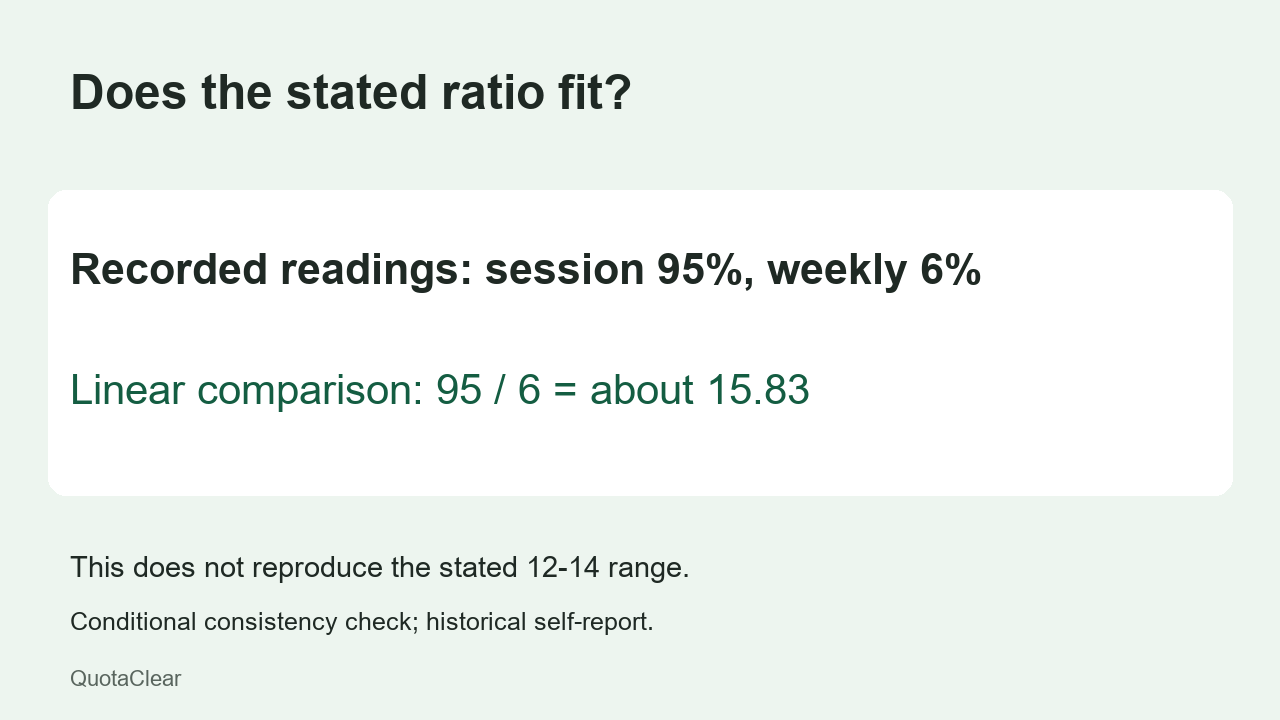
An edited record describes a weekly allowance of 12–14 session-equivalents, alongside 95% session usage and 6% weekly usage. The account describes a recent weekly reset and attributes all of that weekly usage to the same session.
Our consistency check: if the percentages represent matched consumption and both counters scale linearly for that work, the implied multiple is 95 ÷ 6 ≈ 15.83. That does not reproduce the stated 12–14 range.
Ordinary whole-percentage rounding does not reconcile them under that model either. Assume, specifically for this check, rounding to the nearest percentage point. A displayed 95% then represents [94.5%, 95.5%), and 6% represents [5.5%, 6.5%). The possible ratio is greater than 94.5 ÷ 6.5 ≈ 14.54 and less than 95.5 ÷ 5.5 ≈ 17.36. The stated range remains outside it.
This tests the consistency of that record under declared assumptions. It does not identify Claude's actual display-rounding rule or diagnose which reading or assumption needs correction.
Which counter needs a more precise reading?
The same recorded pair also answers a different question: how sensitive is the calculation to a small change in each input?
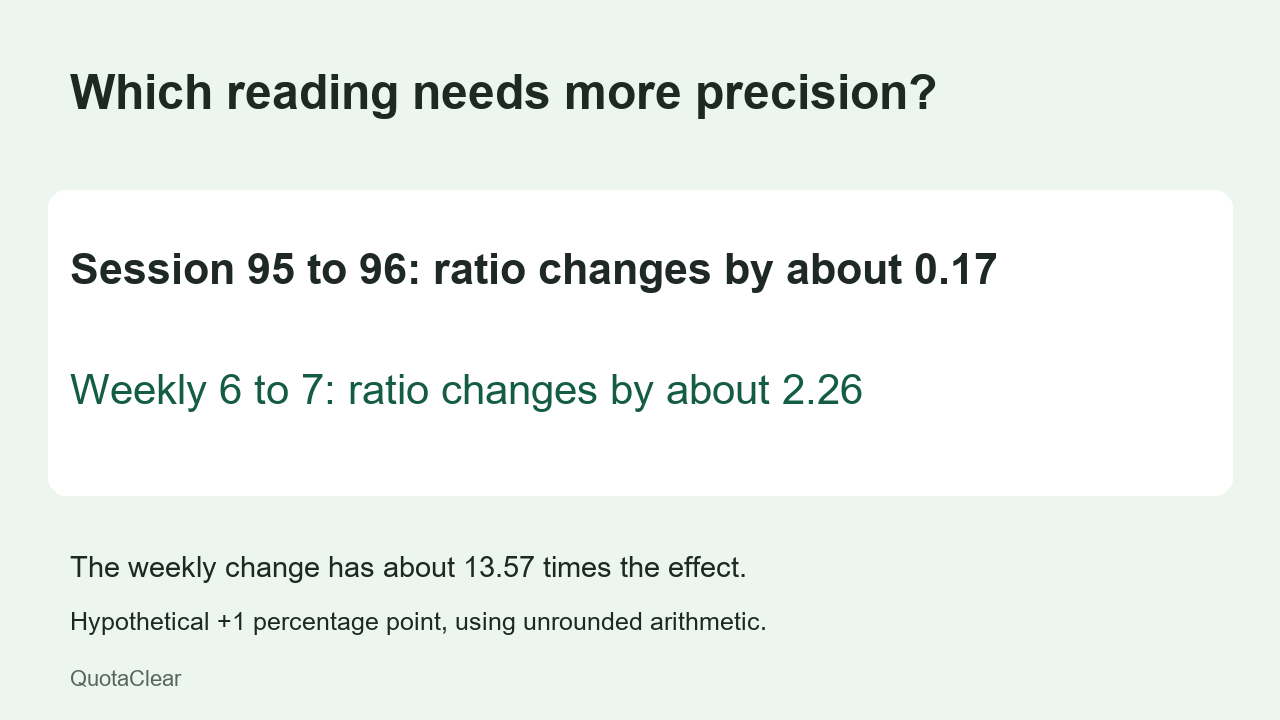
Our sensitivity check: keep the same linear ratio model and compare hypothetical increases of one percentage point. Changing only the session reading from 95 to 96 changes the ratio by 96 ÷ 6 − 95 ÷ 6 = 1 ÷ 6 ≈ 0.17. Changing only the weekly reading from 6 to 7 changes it by 95 ÷ 6 − 95 ÷ 7 = 95 ÷ 42 ≈ 2.26 in the opposite direction. Using the unrounded changes, the second effect is (95 ÷ 42) ÷ (1 ÷ 6) = 95 ÷ 7 ≈ 13.57 times as large.
For this pair, the weekly input therefore deserves particular precision before comparing nearby claimed multiples. This is an arithmetic sensitivity result, not a measurement of how Claude charges usage. It would remain relevant even if the record supplied no verbal 12–14 claim.
When collecting another example, preserve the finest readings actually available. Do not add decimal places the interface did not show.
Can a rounded cost table still have the right total?
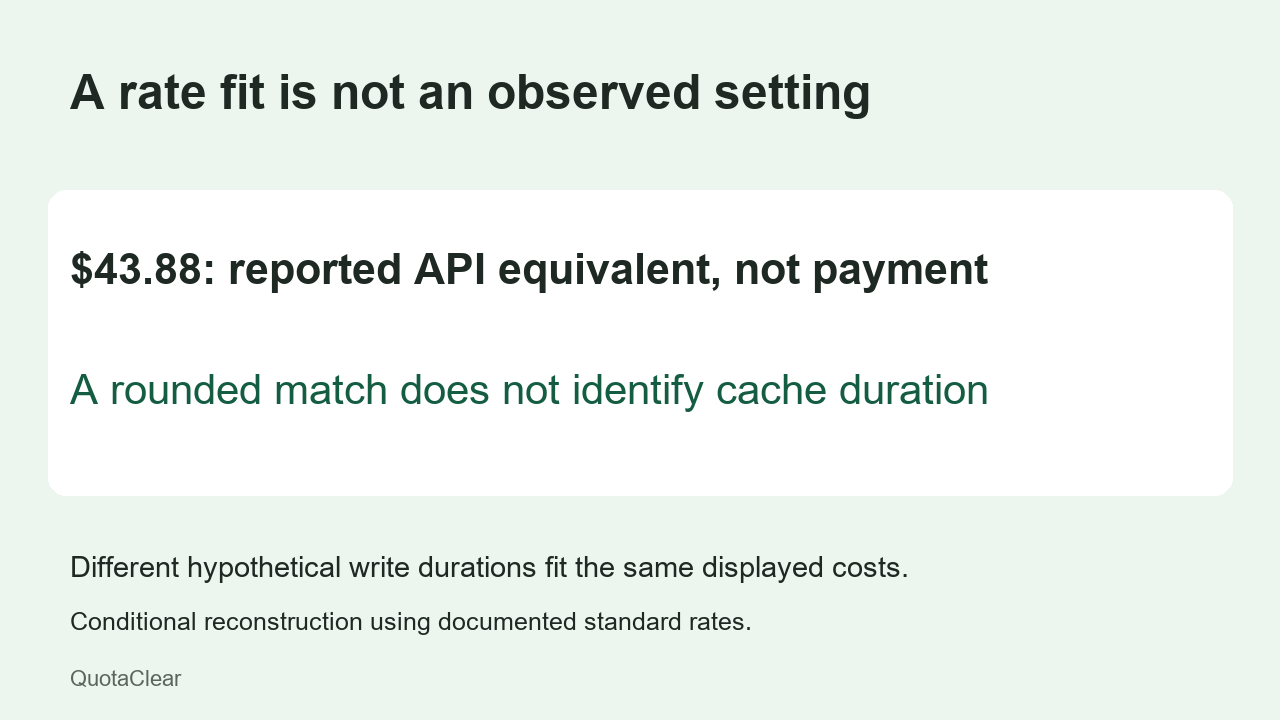
An accompanying token record gives an estimated API equivalent of $43.88. Its category costs are rounded for display. The author identifies the workload as Opus 5.5.
Our reconstruction: price the reported token categories at the documented standard model rates, assuming one-hour cache-write pricing, and round only after adding the unrounded category costs. This reproduces both the stated total and the displayed category amounts. A discrepancy produced by adding already-rounded rows therefore does not establish an incorrect total in this record.
The rate basis is the official Opus 5.5 pricing documentation. This is a conditional reconstruction of an estimate, not proof that the account paid that amount.
Does a successful reconstruction reveal the cache duration?
Our identifiability check: it does not uniquely identify the write duration in this record. As a hypothetical counterexample, price one of the reported cache-write tokens at the shorter-duration rate and the remaining writes at the longer-duration rate. The rounded write amount and rounded grand total both remain unchanged from the all-longer-duration calculation.
Those two different assignments fit the same displayed costs. The rounded table therefore cannot distinguish them. This counterexample does not claim that mixed durations actually occurred; it shows why a rate fit alone is insufficient evidence of the actual duration.
Keep the cache-duration assumption attached to the reconstruction rather than relabeling it as an observed account setting.
Does the cost reply establish a Max allowance ratio?
The original account describes upgrading from Pro to Max after its Pro check. The accompanying cost record provides a token valuation rather than a Max session-and-week counter pair.
Our scope check: that valuation cannot substitute for a measured Max allowance ratio. Establishing an API equivalent and establishing a relationship between two account counters require different observations. The upgrade statement does not supply the missing Max readings.
For a usable comparison, retain the plan attached to each record, its sample unit, the named counters and the calculation assumptions. Keep allowance comparisons, API valuations and payments in separate columns. For the account-level rules, see the Claude Pro usage limit guide.