Retry a Claude limit error only after identifying what stopped the request. An API rate limit may allow a delayed retry; a confirmed monthly spend cap will not be repaired by a short retry loop. A subscription reset message is a different signal. The status code alone cannot choose the remedy.
Should You Retry a Claude Usage Limit Error?
1. Classify the refusal before choosing a timer
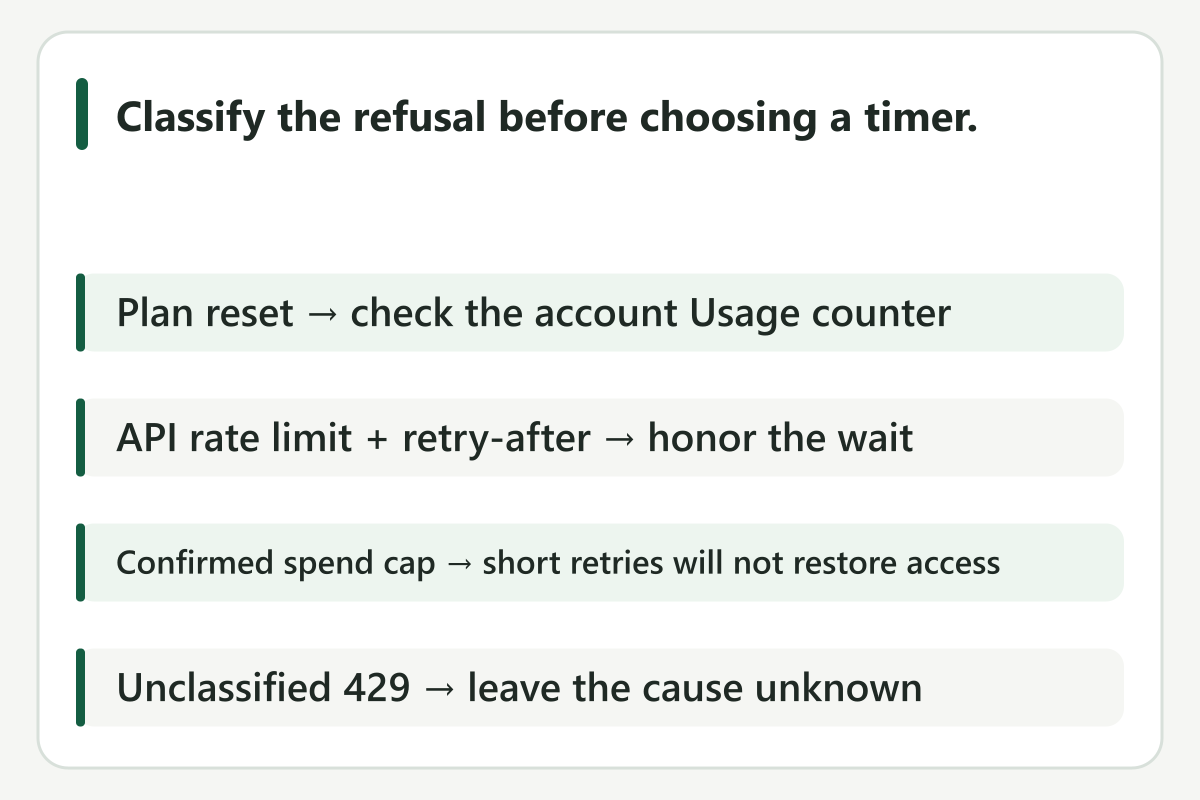
Anthropic documents request, input-token and output-token rate limits for the Messages API. A retry-after header gives a wait in seconds. Waiting that long is an earliest retry point, not a promise that competing traffic or another constraint will let the next request succeed.
The documented tier spend-cap response is also HTTP 429 with rate_limit_error. On the Messages API, error.details.error_code identifies enforced_spend_limit_reached; that response has no retry-after header. Repeating it does not restore access. Read the current Console limit and stated resumption information instead of substituting a subscription countdown.
Anthropic says its official SDK automatically retries transient errors twice by default, respects retry-after when present and offers max_retries to configure the behavior. This is the API SDK contract checked today, not a claim about every Claude Code release or an unofficial wrapper.
Claude subscription use is shared across its product surfaces. An API response header is not a measurement of that subscription pool. If the problem is a named session or weekly allowance in Claude, use that account’s displayed reset information rather than interpreting our synthetic seconds as its reset schedule.
2. Count the retries you already have
Our nested-retry control sets two retries inside a client and three retries outside it. With every attempt failing and neither layer stopping early, the inner layer makes three attempts per outer call; the outer layer makes four calls. Enumeration returns 3 × 4 = 12 attempted sends for one job. Turning off the outer retries leaves three, not two. These are attempts, not twelve completed generations or twelve proven charges. The multiplication applies only while both layers exhaust their budgets; early success would shorten the trace.
3. Compare timelines, not just retry counts
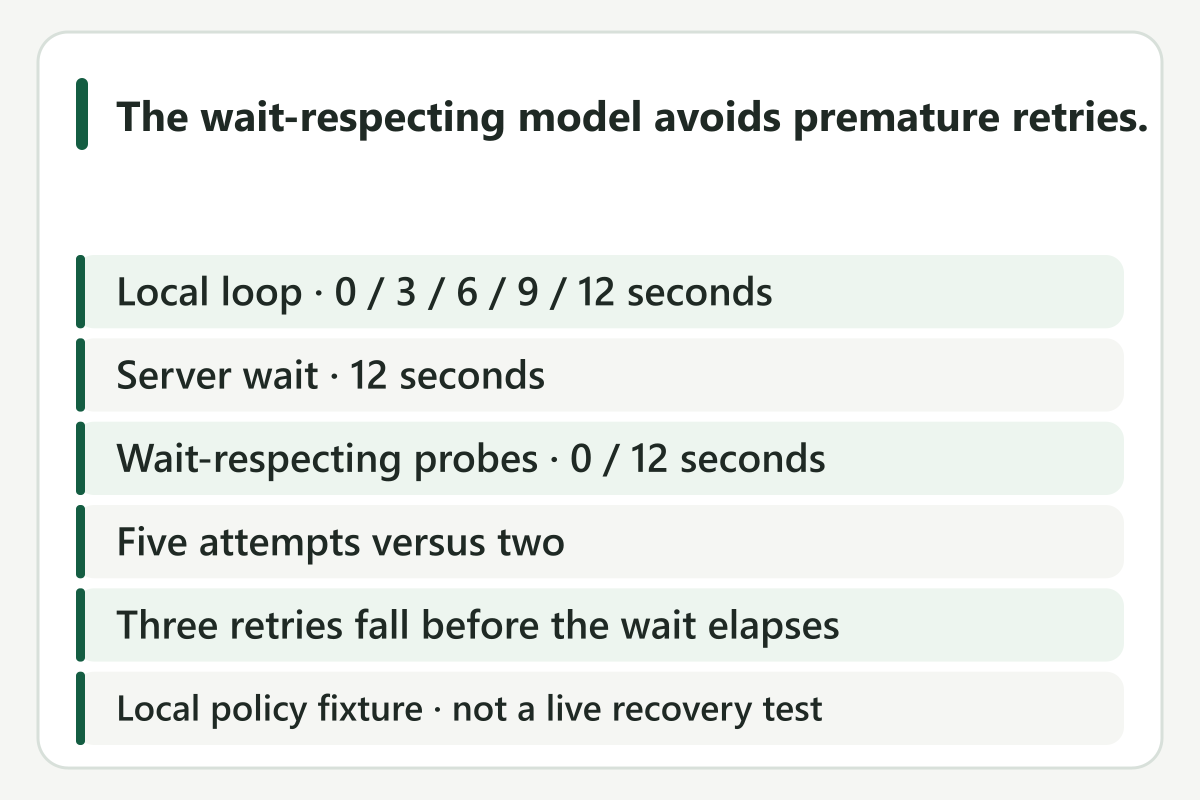
Our single-worker control chooses a server wait of twelve seconds and a wrapper that retries every three seconds. The trace is 0, 3, 6, 9 and 12 seconds: five attempted sends, with the three middle retries falling before the chosen eligibility time. A header-respecting control sends at 0 and 12 only. The difference is three premature attempts, not three measured quota savings. Both controls have the same first eligible retry time; the extra traffic buys no earlier eligible attempt in this fixture.
4. Coordinate only the workers sharing the limit
Our concurrency control starts four identical workers against the same chosen twelve-second gate. Independent three-second loops enumerate 4 × 5 = 20 sends through second twelve, sixteen of them before the gate opens. A deliberately coordinated control sends one initial probe and one recovery probe: two sends, one before eligibility. That is eighteen fewer attempted sends for this designed recovery probe, not an eighteen-request capacity gain. It does not complete four jobs, and a shared gate would be wrong if the workers actually belonged to independent limits.
5. Make the deadline fit the retry budget
Our deadline control permits three total attempts, chooses a seven-second wait after each failure and imposes a ten-second job deadline. The candidate starts are 0, 7 and 14 seconds; filtering out starts at or beyond ten leaves 0 and 7. The third allowed attempt cannot start inside this deadline. Raising the attempt cap would not help this schedule. This trace assumes instantaneous failed responses; adding real request time can leave even less room. A retry count and a time budget therefore answer different questions in this exact control.
6. Preserve the server wait as a lower bound
Our wait-selection control supplies a seven-second server wait and a two-second local backoff. Taking the smaller delay schedules a retry five seconds before the stated wait has elapsed. Taking max(7, 2) yields seven seconds. Adding a chosen one-second nonnegative jitter yields eight; subtracting that jitter yields six and breaks the lower bound. These calculations test how two settings interact. They neither require a one-second jitter in production nor guarantee that the seven- or eight-second retry will be accepted.
7. Check the timer’s units
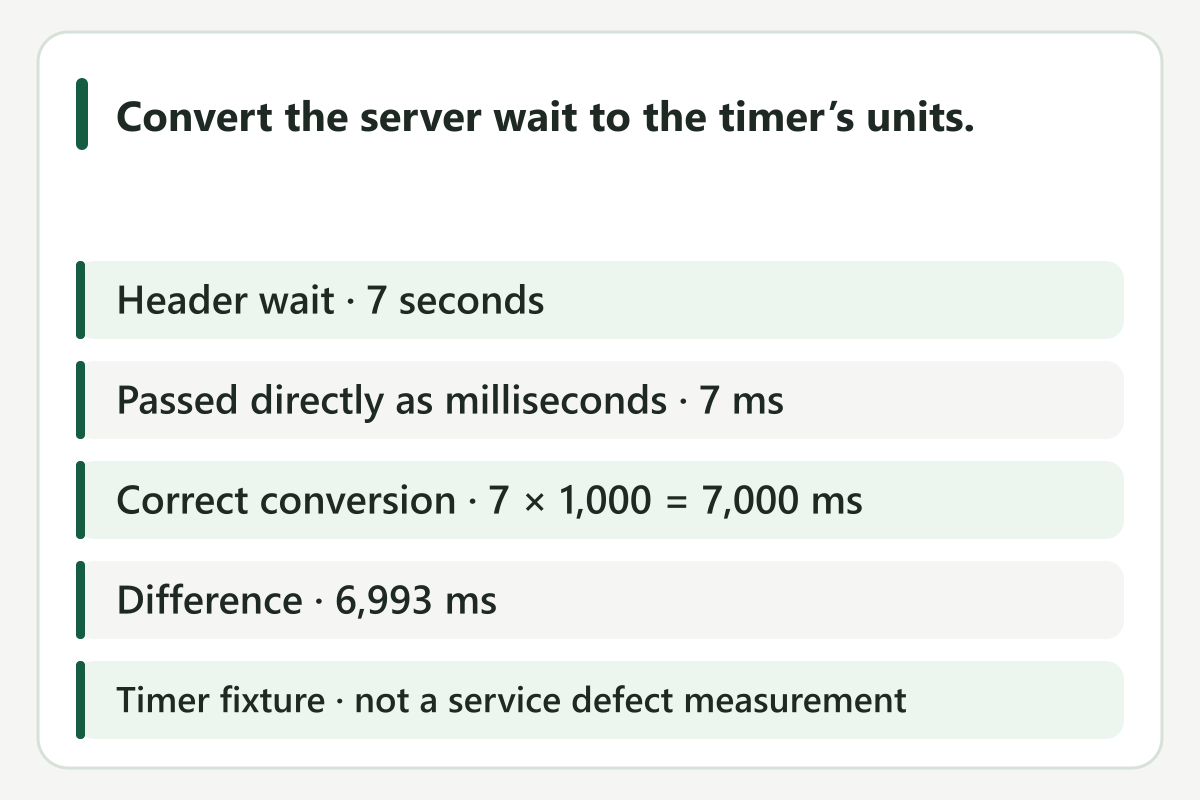
Our timer-unit control supplies the header string 7 to a timer whose input is milliseconds. Passing the parsed number directly schedules seven milliseconds. Converting seconds correctly schedules 7 × 1,000 = 7,000 milliseconds, a difference of 6,993 milliseconds. Both branches can print the same source value in a log, so a matching header log does not validate the actual delay. The defect here is the chosen timer integration, not a measured defect in Anthropic’s SDK or evidence that the account reset early.
Download the offline comparison table (CSV)
8. Leave an unclassified response unresolved
A missing retry-after header alone does not prove a spend cap. Our classification controls distinguish a confirmed enforced_spend_limit_reached body from a headerless 429 with no identified cause. The latter remains unknown. Do not manufacture a reset time from absent metadata, or classify a subscription message by the shape of an unrelated API example.
First identify the endpoint and the error body. For a confirmed spend cap, stop the short recovery loop and inspect the Console condition. For a temporary rate error, identify the retry layer already active, respect the server wait and retain a finite attempt and elapsed-time budget. Coordinate only workers that truly share the limiting scope. If the response is still unclassified, expose that uncertainty rather than silently retrying forever.
The local traces omit network latency, competing clients, changing server capacity and real output generation. They establish the behavior of the explicit toy policies only. They cannot price a failed request, estimate tokens remaining, establish that every 429 is temporary or predict when an actual subscription will resume.
The useful distinction is between another permitted attempt and restored capacity. A timer can authorize the former in your code; only a real response can demonstrate the latter. Keep this page’s retry-planning examples separate from the account-level allowance and context explanations in our limits guide.