No. In our local test of the official Claude Python SDK, an early-ended stream returned normally while its reply was still incomplete. Even get_final_message() returned a partial object. When investigating a Claude usage limit error, preserve the text you received and check the ending; a loop finishing is not enough.
Does a Finished Claude Stream Mean a Completed Reply?
We ran anthropic 2.6.0 with Python 3.12.14. The real SDK read responses from our own local server. These were synthetic responses, not traffic from a Claude account, and they provide no measurement of allowance, billing, service reliability, or how often this happens.
The same text, different endings
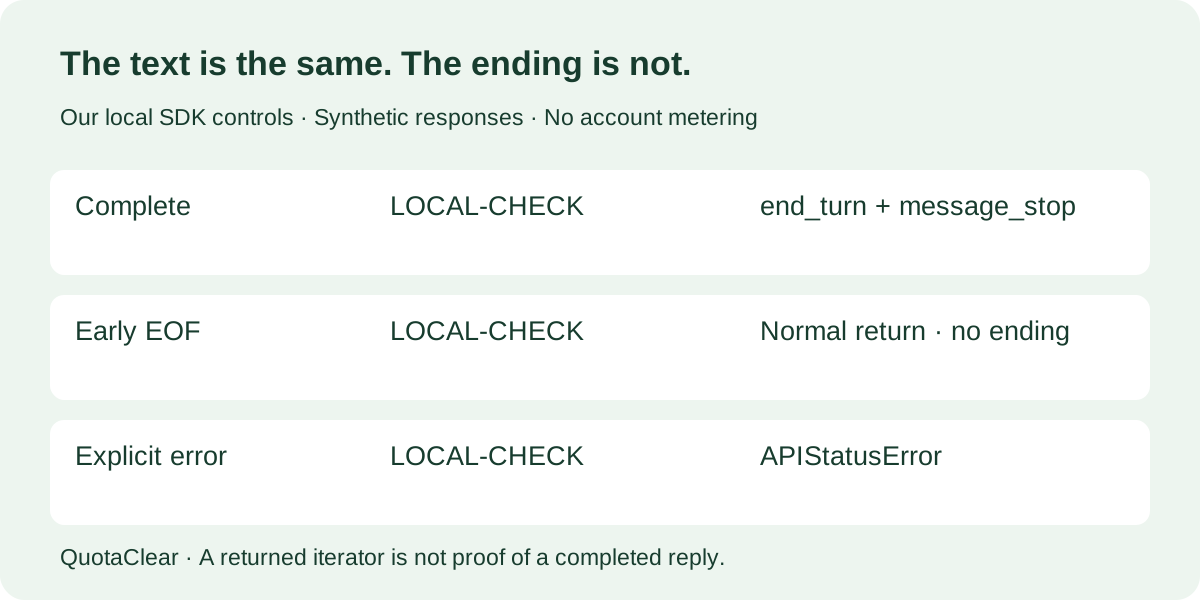
Every control supplied the text LOCAL-CHECK. We changed the ending after that prefix: a complete ending, a quiet EOF, or an explicit error event. Our local server supplied complete HTTP 200 bodies; the quiet-EOF fixture was an incomplete Messages event sequence, not a broken TCP transfer. The normal Messages event sequence includes a final message_stop; that fixture deliberately omitted it.
| Ending supplied | Text received | Iterator outcome | Ending evidence |
|---|---|---|---|
| Complete ending | LOCAL-CHECK | Returned normally | message_stop received; stop_reason=end_turn |
| Early EOF after the text | LOCAL-CHECK | Returned normally | No message_stop; no stop reason |
| Error event after the text | LOCAL-CHECK | Raised APIStatusError | No completed ending recorded |
For this exact input, both the complete stream and the early-ended stream finished the iteration without an exception. The explicit error took a different path. Do not label a saved prefix as a complete reply just because your loop reached its end.
The final-message helper did not close the gap
We also consumed the early-end response through client.messages.stream(...).text_stream, then called get_final_message(). It returned a message object containing LOCAL-CHECK, with stop_reason still null. No exception was raised in that control. The returned object was therefore something to inspect, not a completion certificate.
Record the stop reason as it actually arrives. If the terminal event or expected reason is missing, retain the response as partial. Handle an explicit error separately from a quiet end. Check what the ending means for your particular task before calling the work finished.
Did the SDK silently send another request?
Our server logged one request for each invocation, through both reading APIs and every ending in the table. No additional automatic send appeared in this run. This is the observed local send trace, not a promise about other errors, SDK versions, or clients. If recovery is needed, choose it explicitly in your application rather than assuming that another reply is already on the way.
Reproduce the check without an account key
Download our standalone test script and the recorded results. The script needs no account key; it uses a noncredential fixture string with its own local responses.
python -m pip install anthropic==2.6.0
python stream-ending-check-20261108.py
Use the recorded version when comparing results. Keep the received text, terminal-event observation, final stop reason, exception, and request log together. This experiment does not identify a real account’s limiting counter or prove why an actual reply stopped; it gives you a concrete completeness check before you diagnose that separate problem.