Claude Agent SDK Usage Limit: Why the Same Work Can Drain a Session Faster
Switching from Claude Code to an Agent SDK app does not create a fresh subscription allowance. Published measurements have also reported different five-hour meter consumption for comparable work through different entrypoints. That makes the entrypoint worth checking when a familiar workload suddenly reaches its limit sooner; it does not establish a universal multiplier for your account.
On this page
Does the SDK use the same allowance?
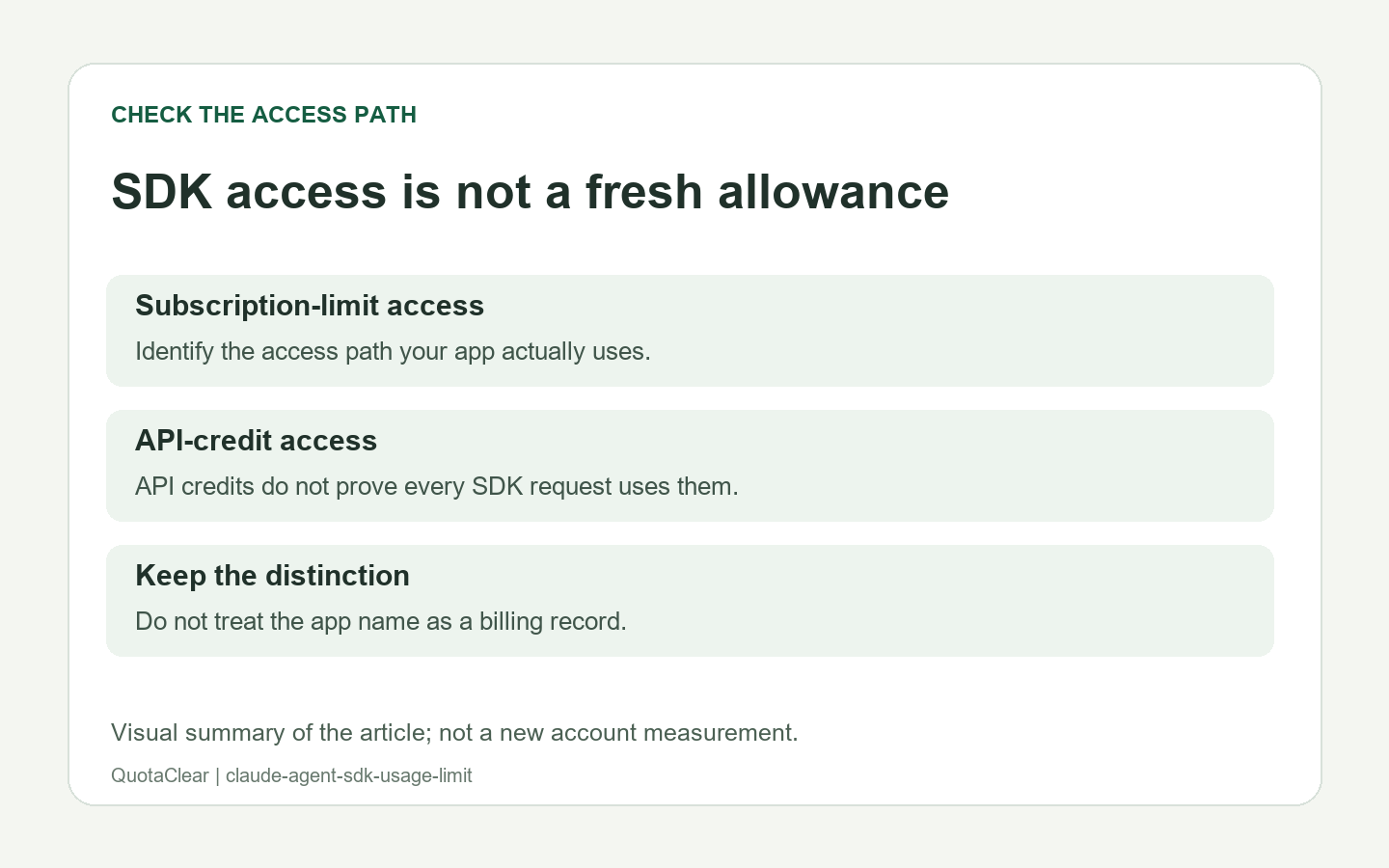
Anthropic’s October 7, 2026 policy update says Max and Team include monthly API credits covering the SDK and other API work, while subscription-limit access remains available for the SDK, claude -p and third-party apps. The existence of API credits does not mean every SDK request has moved away from subscription limits. Identify which access path your app actually uses.
Compare the tests before comparing their multipliers
September 25: headless against an interactive terminal
A September 25, 2026 Max-account report used Claude Code 2.1.282, claude-opus-5 and high effort. Its fixed sequence asked for a file read followed by short questions; the same prompts were sent through headless and interactive modes.
It reported a five-hour reading moving from 52% to 60% during the headless phase, then from 60% to 65% during the interactive phase. Other account activity was measured separately in the report.
Our arithmetic is 60 − 52 = 8 percentage points and 65 − 60 = 5 percentage points. Dividing these raw meter changes gives 8 ÷ 5 = 1.6, but that is not a token-normalized comparison. It omits the report’s corrections for token mix and other activity. Raw meter differences and normalized results answer different questions.
October 17: entrypoint labels inside a test harness
An October 17, 2026 Team-plan run used Claude Code 2.1.300, Agent SDK 0.3.276, claude-opus-5-5 and high effort. It reported the following weighted-token yield per percentage point of the five-hour allowance.
| Test arm | Reported weighted tokens per point |
|---|---|
sdk-ts | 80k ± 4k |
sdk-cli | 84k ± 7k |
claude-vscode label | 238k ± 7k |
Important qualification: this harness emulated the claude-vscode entrypoint label through an environment variable. It was not a measurement of the entire VS Code graphical application.
The published method used identical prompts, rotated the arm order and measured per-request utilization events. Its SDK usage lookup was a fallback with a slower refresh, which could otherwise assign usage to the wrong block.
Using the rounded table inputs, our simple yield ratios are 238 ÷ 80 = 2.975 and 238 ÷ 84 = 119/42. These calculations describe that table, not a guaranteed improvement from changing editors. The reported ± values belong to the published measurements; the simple divisions above are not a new statistical fit.
October 25: T3 Code against the interactive TUI
A separate October 25, 2026 tracking report describes one Max account, no other account activity during the test, and both counters starting at zero. Its normalized cost unit was percentage points of the five-hour window per million cache-write tokens.
| Run, in reported order | Session change | Normalized cost | Weekly change |
|---|---|---|---|
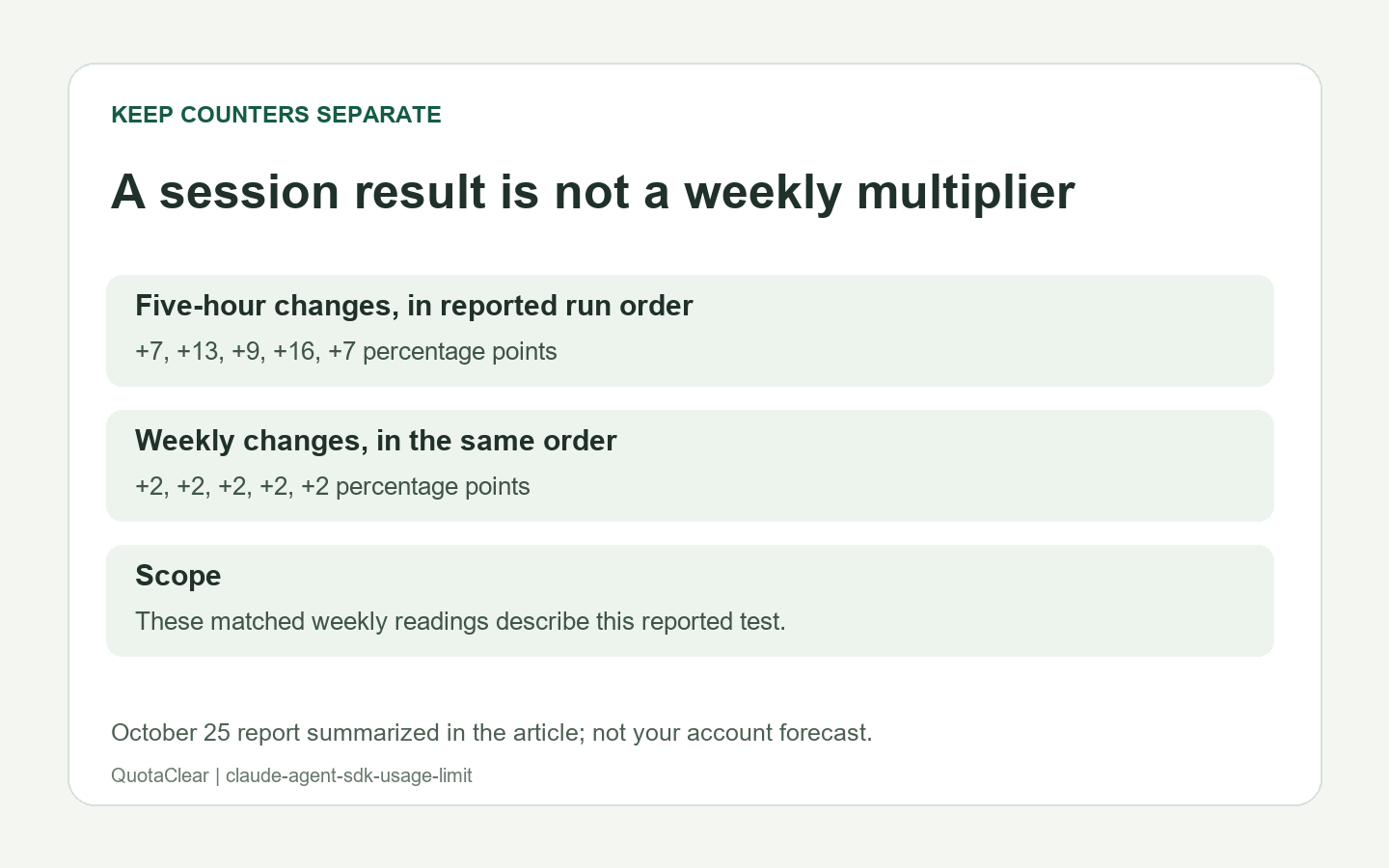
| Interactive TUI, first | +7 points | 1.14 | +2 points |
| T3 Code, first | +13 points | 1.94 | +2 points |
claude -p | +9 points | 1.83 | +2 points |
| T3 Code, second | +16 points | 1.97 | +2 points |
| Interactive TUI, second | +7 points | 1.11 | +2 points |
Our pairwise calculations from those reported normalized costs are 1.94 ÷ 1.14 = 97/57 and 1.97 ÷ 1.11 = 197/111. The matching weekly increases do not turn either result into a weekly-consumption multiplier. They show the weekly readings matched in this test.
Why the results differ without cancelling each other out
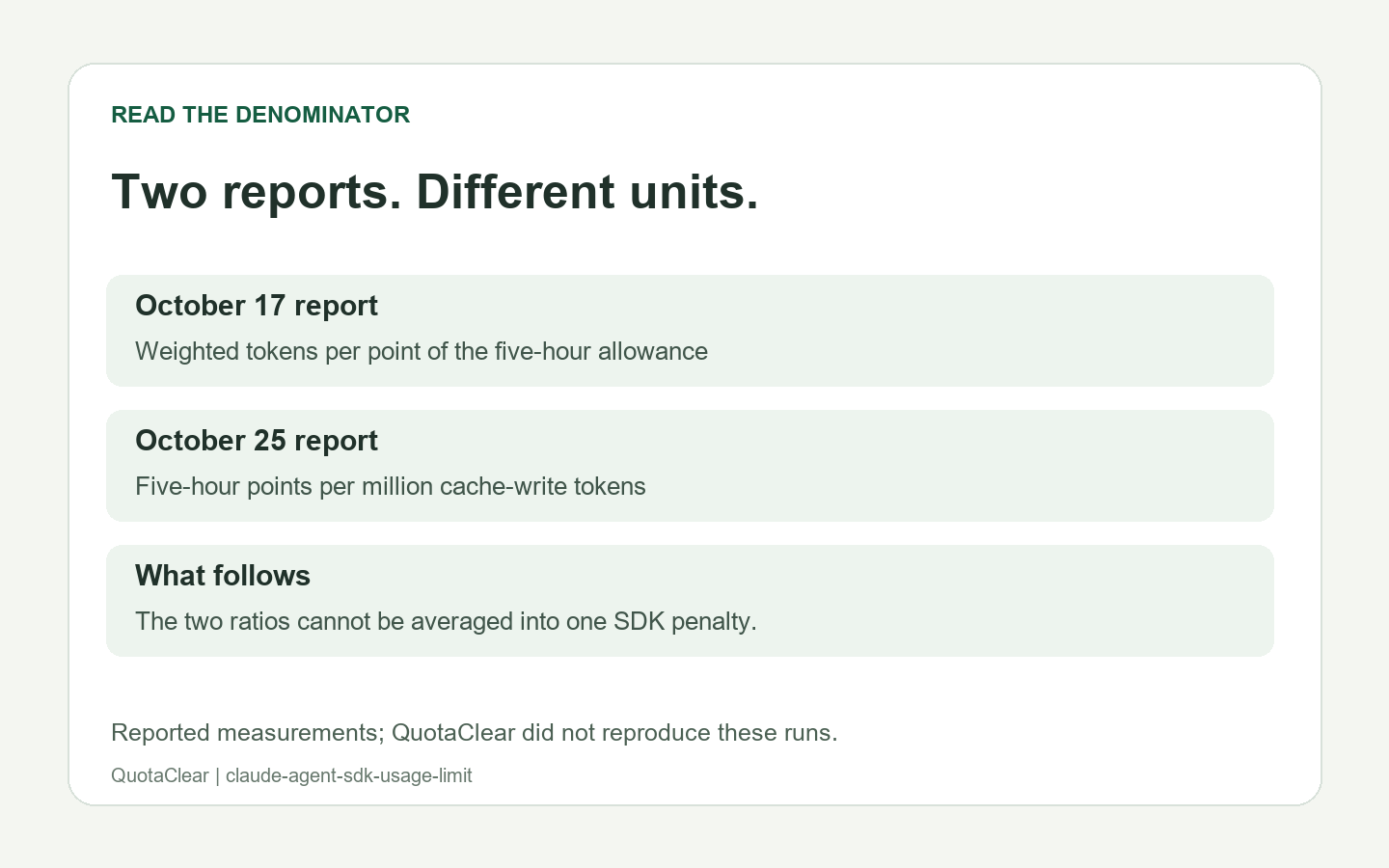
The October 17 comparison uses weighted tokens and an emulated VS Code label. The October 25 comparison uses a cache-write-normalized cost against the interactive TUI. Changing both the denominator and the reference arm changes the meaning of the ratio. These reports cannot be averaged into one SDK penalty.
What remains unknown here is your account’s present metering, whether the same behavior affects your app version, and whether Anthropic has changed it since each measurement. Neither a historical run nor a policy allowing SDK access supplies those missing observations.
What to do when an SDK app reaches the limit first
- Check whether the app uses your subscription or an API credit path.
- Compare the session counter separately from the weekly counter.
- If the same task works differently in the interactive terminal, compare matched model, effort and workload before blaming longer prompts or broken caching.
- Do not change entrypoint labels to impersonate another client. The emulated label above explains a test design, not a recommended quota workaround.
A useful support question is narrower than “Why are Claude limits worse?” Ask whether your subscription-authenticated entrypoint is being metered differently for a matched workload. For the separate problem of rising usage immediately after reset, see usage after a reset.