No. A missing Claude usage-limit field does not establish zero usage or a full allowance. Keep “unknown” separate from an explicitly reported 0%, and keep context usage separate from session and weekly usage. A blank custom status bar is not proof that your account is blocked, either.
Does a Missing Claude Usage Limit in the Status Line Mean Zero Usage?
1. Identify which percentage is missing
The documented fields are context_window.used_percentage for context, and rate_limits.five_hour.used_percentage and rate_limits.seven_day.used_percentage for the two usage windows. They describe different quantities. Do not relabel the context number as your remaining plan allowance.
Anthropic documents that individual rate-limit windows can be absent, that rate_limits is conditional on supported account or gateway configurations and the first API response, and that expired windows are dropped. Context percentages may be null early in a session. Missing data alone does not identify which condition applies.
2. Compare absent data with an actual zero
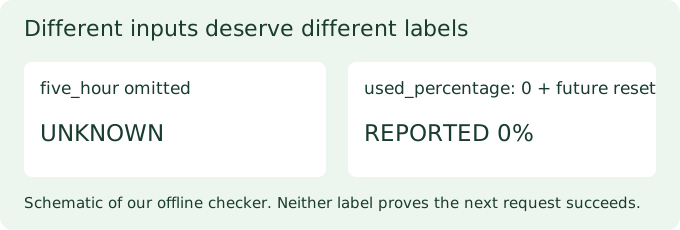
Case A feeds our checker context usage of 38% and a weekly reading of 47%, with a future reset, but omits the five-hour window. The executed output keeps context at 38 and weekly usage at 47 while marking five_hour as unknown_missing. A deliberately naive missing-value fallback would print 0 for that last field, inventing a number absent from the input. This fixture demonstrates a diagnostic difference between the two renderers, not an observation that a real account used exactly these amounts.
Case B supplies a numeric five-hour value of 0 with a future reset and a null weekly window. Our output preserves 0 as reported and classifies the weekly window as unknown_missing. A truthiness condition would hide the valid zero along with missing data. Compared with Case A, a zero-filled display would erase the distinction between an omitted window and an explicit numeric reading; our outputs retain it. The reported zero still says nothing about how much work the account can complete next.
3. Do not let a reset timestamp supply a missing amount
Case C supplies a null context percentage and a null five-hour percentage, despite providing a future five-hour reset. The result is unknown context and unknown_null_or_missing_percentage for five_hour. The reset timestamp does not fill in the missing amount. In this exact input, replacing null with zero would create two numerical claims from no numerical readings. Our checker declines both claims while accepting the JSON itself; this is missing information, not necessarily a syntax error or evidence of exhausted capacity.
4. Reject accidental type conversions
Case D supplies the JSON boolean false as a five-hour percentage and the string "0" as a weekly percentage. Our Python checker returns invalid_percentage for both. An ordinary Python numeric-type check can accidentally accept false because bool is a subclass of int; our exact-type check excludes it. Automatically converting the string would also erase a schema mismatch. This deliberately strict policy tests the supplied payload without claiming that Claude normally emits either malformed value, or that every custom tool must choose identical validation behavior.
5. Retire an expired reading without inventing a refill
Case E holds a five-hour reading of 82% fixed and chooses its reset instant to equal the checker’s clock. One second before that boundary, our output reports 82; at the boundary it changes to expired_unknown. The weekly 47% reading, with a later reset, remains reported in both runs. We neither carry the old 82 forward nor invent a replacement 0. This is a comparison of two local evaluations of one frozen input, not evidence that a live account’s server allowance recovered at that instant.
6. Keep the amount separate from the reset boundary
Case F supplies a five-hour percentage of 62 without a reset, alongside weekly usage of 62 with an ISO-formatted reset string. Our checker keeps both numeric readings but labels both reported_reset_unverified. Its native-payload reset validator expects numeric epoch seconds; it does not silently parse a different timestamp representation. Both percentages remain visible without an asserted freshness guarantee. This separates a readable amount from a validated reset boundary, instead of discarding the amount or pretending a time conversion was supplied by Claude.
7. Give the spend field its own range
Case G places the same numeric 125 in a five-hour window and a gateway spend window, both with future resets. The first becomes invalid_percentage; the second remains reported at 125. Applying one universal ceiling would either accept an out-of-range session reading or hide the spend overage. Our two outputs therefore differ despite identical numeric input. The test uses the documented distinction between subscription-window percentages and a spend percentage that can exceed 100; it does not measure an actual overspend or a bill.
The official status-line documentation allows gateway spend percentages above 100. Treat this field separately from five-hour and weekly percentages. Our diagnostic labels are QuotaClear’s own output vocabulary, not official Claude status codes.
Run the offline checker
Download the checker, inspect its source, then pass a saved JSON object on standard input. It prints classifications and exits; it does not fetch usage, read login files, write a cache or edit your status-line settings. Use --now with Unix seconds to replay a known boundary. Without that option it uses the local machine clock, so clock accuracy affects expiry classification.
Download the Python checker · Download inputs and results (JSON)
python qc-statusline-check-20261102.py < payload.jsonFor an absent usage window, show a placeholder and check the same account’s own Usage screen if a plan decision depends on it. For invalid input, inspect the producer or conversion before changing the display. For an expired record, obtain a new observation. None of these diagnostic states is a command to purchase more usage or a reason to change account credentials.
This checks the representation of one supplied payload. Even a well-typed percentage can be stale or belong to a different account snapshot; the checker cannot independently authenticate it. It cannot decide whether the next Claude request will succeed, determine why a field disappeared or convert a percentage into a token budget.
Fix the display without inventing a balance. An explicit zero, an unknown amount, an expired observation and a context percentage should remain distinguishable when you return to work. For a failed attempt to fetch usage rather than a missing status-line field, use our separate usage-data-load-error guide.
Read the usage-data-load-error guide. Read the account limits guide.