A Claude usage burn rate can support a conditional pace calculation, but it cannot guarantee how much work remains. Compare readings from the same account and limit window, then stress-test the result against changed workload, stale readings and display precision before planning a long task.
Can Your Claude Usage Burn Rate Predict When You Will Run Out?
1. Establish what the meter measures
Anthropic says usage depends on conversation length and complexity, model, effort and features. It also distinguishes usage over time from the context window of a conversation. A recent meter movement therefore does not supply a fixed cost for every future message.
For supported accounts, use the relevant Usage readout and its reset information. Keep five-hour and weekly readings separate. The status-line documentation identifies each rate-limit window independently; an absent value is not a substitute for a measured zero. The calculator cannot verify the account or window identity you enter.
2. Keep the arithmetic separate from the prediction
For this page, r = (current percentage used − earlier percentage used) ÷ elapsed minutes. From a fresh reading, the constant-pace time to the displayed 100% threshold is (100 − current percentage used) ÷ r. These are percentage points per minute, not tokens per minute. The formula is ordinary arithmetic, not a new metering rule.
3. Stress-test the future workload
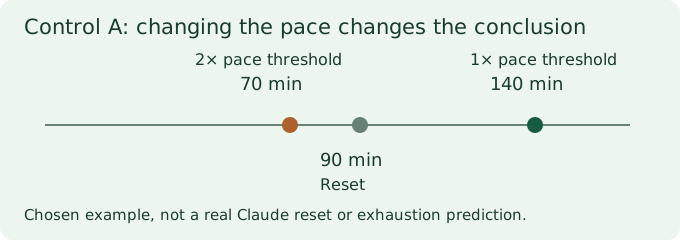
Control A chooses 20% and 44% used, sixty minutes apart, with ninety minutes until reset and a fresh latest reading. The calculation gives (44 − 20) ÷ 60 = 0.4 points per minute, or 24 per hour. At unchanged pace, (100 − 44) ÷ 0.4 = 140 minutes, beyond the chosen reset. At twice that pace the result is seventy minutes, before reset; at half pace it is 280 minutes. The same observed pair supports opposite before-reset conclusions once the future-workload assumption changes. None of these factors was measured on Claude.
4. Treat an exact reset-boundary tie as a tie
Control B chooses a rise from 60% to 80% in thirty minutes and a reset thirty minutes away. Its constant-pace calculation is (100 − 80) ÷ ((80 − 60) ÷ 30) = thirty minutes: exactly the reset boundary. Our program labels this at_reset rather than safely before or after. Rounding the result upward to a whole hour would hide that tie. Equality in a local model does not establish the server’s ordering of a reset and a new request, so this control does not promise an uninterrupted final task.
5. Refuse an unlimited result from a flat sample
Control C chooses 30% at both ends of a twenty-minute sample. Our program returns no_positive_observed_pace and produces no exhaustion time. A denominator of (30 − 30) ÷ 20 is zero; replacing the undefined division with an “unlimited” label would add a capacity claim that the two inputs do not contain. The result also does not prove Claude was idle or that the next task will cost nothing. This is a refusal to extrapolate from the selected flat sample, not an observation of free usage.
6. Stop when the counter decreases
Control D chooses 72% followed by 12% over thirty minutes. Blind subtraction yields −2 points per minute and a negative threshold time. Our program instead returns counter_decreased. It does not relabel the sixty-point drop as a credit or a consumption saving. A reset, account mismatch, correction or another discontinuity would require its own evidence; the numbers alone do not identify which occurred. This control therefore tests that a decreasing counter cannot accidentally produce a reassuring forward runway in our calculator.
7. Age the reading before using it
Control E reuses A’s 20-to-44 pair but ages the latest reading. Under an explicitly selected assumption of unchanged pace during a thirty-minute gap, another 0.4 × 30 = twelve points would have been used, leaving a hypothetical 44 points and 110 minutes at baseline pace. Treating that stale reading as fresh would still print 140. With a 150-minute gap, the same extrapolation has already crossed 100, and our program stops with projection_already_crossed. Neither output establishes the present balance; both show why the observation time changes the interpretation. These two evaluations are one age-control group.
8. Reject unmatched windows
Control F supplies the exact same numerical inputs as A but marks the account, meter or reset window as unmatched. Our program returns unmatched_window without calculating a rate. A numeric-only implementation would still return the attractive 140-minute baseline even though its consumption comparison was not established. The flag is a user assertion that our tool cannot independently check. This paired control demonstrates what validation changes in the output; it does not claim that every matched pair is accurate, fresh or representative of the next workload.
9. Test the precision you actually have
Control G deliberately assumes nearest-whole-percentage rounding, without asserting that Claude uses it. Both chosen one-minute pairs, 19.501 → 21.499 and 20.499 → 20.501, display as 20 → 21 under that rule. Yet (100 − current) ÷ (current − earlier) gives about 39.29 minutes for the first pair and 39,749.5 for the second; using the displayed labels gives 79. The open rounding intervals allow a runway approaching 39.25 minutes with no finite upper bound. Those bounds describe this chosen rounding model, not a confidence interval or an account forecast.
Try the conditional pace stress test
The optional reading-age calculation first assumes that the observed pace continued during the gap: hypothetical remaining points = 100 − current − r × age in minutes. Each future scenario divides that hypothetical remainder by r times the chosen pace factor. A sample age of zero avoids this extra extrapolation. A fresh reading is preferable to treating the extrapolated remainder as a measurement.
Enter the two percentages used, their elapsed time, the time from now until reset and the age of the later reading. Confirm that both readings describe the same account and limit window. The tool runs entirely in this page without sending or storing the entered values. Its half-, unchanged- and double-pace scenarios are stress tests, not forecasts with assigned odds.
Download chosen inputs and calculated results (JSON) · Download the calculation source
If the before-reset conclusion changes across scenarios, do not describe the plan as guaranteed to last. If readings are flat, decreasing, unmatched or too old for the intended decision, obtain better observations rather than increasing the displayed precision. When a task changes model, effort, context or tool workload, a previous pace remains historical evidence rather than a price for the new task.
This calculator cannot discover hidden quota rules or predict interruptions unrelated to the selected meter. It also cannot establish that a percentage is current merely because it is numeric. Different future activity can invalidate the constant-pace assumption immediately. The exact local controls add reproducible examples; the general idea of calculating pace from two readings already exists.
Use the result to identify which assumption your plan depends on. Do not turn a scenario into a promise of productive hours. For a missing input rather than a pace question, read our status-line diagnostics; for the account rules themselves, use the Claude limits guide.
Read status-line diagnostics · Read the Claude limits guide.